
PROGRAM NOTES

Starlight Adventure
Alfred Music
2024 • Grade 2 • 2:30
Program Notes by Nadine Ghanem, Flute
Starlight Adventures, by Adrian B. Sims, begins with the twinkle of a single star on a quiet night and concludes with a blazing show of constellation patterns after a colorful musical adventure along the way. An engaging and harmonically interesting new work that is approachable by developing ensembles! -adrianbsims.com
I think Starlight Adventures is a very beautiful piece and a great way to start off our concert. This piece reminds me of falling into deep thought on a long car ride and looking at the stars. The flute solo starts off the piece with a smooth and delicate sound. It is uplifting as the rest of the band comes in and takes over the melody. I love the melodies from the altos and flobonets because their parts have so much feeling and passion, the brass create a beautiful base coat that helps lift up the melody, and the percussion adds effect to the band. These parts together help paint a picture of a night sky, with the percussion as the stars and the band as the different colors of the sky. As a flute player, I love how red we can play and how we float on top of the rest of the sounds. The end of the slow part adds suspense as it moves into the fast part. In this part, the brass, particularly the trumpets, start to take over some of the melody and build intensity. I love how this part is a much more bouncy style, unlike the first part, which is much more flowy. These parts together help add details to the picture, and resemble the end of the night and a start to a new day – or the rest of the concert. My favorite parts of this piece are how each note leads to the next, the changes in style, and how each instrument is featured beautifully.
Cajun Folk Songs
Manhattan Beach
1991 • Grade 4 • 6:45
Program Notes by Winn Chung, Flute
Cajuns are descendants of the Acadians, a group of early French colonists who began settling in Acadia (now Nova Scotia) around 1604. In 1755 they were driven out by the British, eventually resettling in South Louisiana. Today there are nearly a million French-speaking descendants of the Acadians living in Louisiana and parts of Texas, preserving many of the customs, traditions, stories, and songs of their ancestors.
"La Belle et le Capitaine" tells the story of a young girl who feigns death to avoid being seduced by a captain. Its Dorian melody is remarkably free, shifting back and forth between duple and triple meters.
"Belle" is about a man who goes away to Texas only to receive word of his sweetheart's illness, forcing him to return to Louisiana. Finding her unconscious upon his return, he pawns his horse to try to save her, to no avail. The folk melody is sometimes varied rhythmically, texturally, and coloristically, and an original melody is added for variety. Clarity, transparency, and momentum are the important factors in order to preserve its dance-like effect.
Cajun Folk Songs is composed as a tribute to the people of the old Cajun folksong culture with hopes that their contributions will not be forgotten. The work is dedicated to the Murchison Middle School Band, Austin, Texas, Cheryl Floyd, Director, who commissioned the work and gave its premiere on May 22, 1990.
What this piece means to me:
I like this piece because it has diverse ideas and has memorable harmonies and melodies.
Rizz
Alfred Music
2025 • Grade 3 • 3:00
Program Notes by Grant Johnsrud, Trumpet
The word "Rizz" is a slang term coming from the word charisma. This piece exemplifies the idea of rizz, with a jazzy groove, brass-centered sound, and constant changes of dynamics. This piece quickly became a favorite among the kids. While they thought the title was a bit ironic, the flow is unremarkable. As a trumpet player, I can't tell you how much fun I've had playing this piece with my friends. This piece truly has rizz.
Shark Week!

Manuscript
2025 • Grade 2 • 2:30
Program Notes by Joe Hobbs
Shark Week! is dedicated to the students and staff of the Canyon Ridge Middle School Band. Most notably, head director Amy Allison, who opened Canyon Ridge Middle School in 2004, has devoted her career to building and sustaining this outstanding program. The official mascot of the Canyon Ridge Band has always been the shark, and if you’ve ever visited their band hall, you’ve undoubtedly seen sharks proudly displayed throughout the rehearsal space.
When I was invited to compose a piece for their performance at the 2025 Midwest Band and Orchestra Clinic, the idea of sharks immediately came to mind. I wanted to capture the energy, excitement, and playfulness that both the Canyon Ridge students and their mascot represent. Shark Week! is a fast-paced and spirited work that embodies the adventurous spirit of the Canyon Ridge Band—and, of course, the thrill of sharks. The piece was written using instruments commonly found in every band hall, making it accessible to a wide
range of ensembles. It has been a joy to collaborate with the incredible students and staff of Canyon Ridge Middle School, and I hope audiences enjoy Shark Week! as much as I enjoyed writing it.
A Simple Song at Sunrise
Robert W. Smith
arr. by Evan VanDoren
RWS Music Company
2025 • Grade 3 • 3:00
Program Notes by Pranav Kurupati, Horn
Simple Song at Sunrise is a gentle, heartfelt reflection on the quiet beauty of a new day. The piece begins with a single, unadorned melody—soft, almost hesitant—meant to capture the stillness of early morning before the world fully awakens. As the music unfolds, layers of harmony gradually bloom around the theme, like the slow brightening of the sky as the first rays of sunlight stretch across the horizon.
Rather than striving for grandeur, the piece finds its strength in sincerity. Each line is written to feel personal, intimate, and honest, as though the performers are sharing a small but meaningful memory. Moments of warmth rise and fall, shaped by gentle crescendos that mimic the changing colors of dawn. The middle section grows slightly broader and more confident, representing the quiet determination that often accompanies a fresh start.
Ultimately, Simple Song at Sunrise is about gratitude—about standing in a peaceful moment and recognizing the beauty in things that are often overlooked. As the melody returns, unchanged but newly supported, the piece closes with a sense of calm clarity, leaving both performers and listeners with the soft, reassuring hope that every sunrise carries.
Paceline
Tyler S. Grant Music Works
2018 • Grade 3 • 4:20
Program Notes by DaAe Kim, Oboe
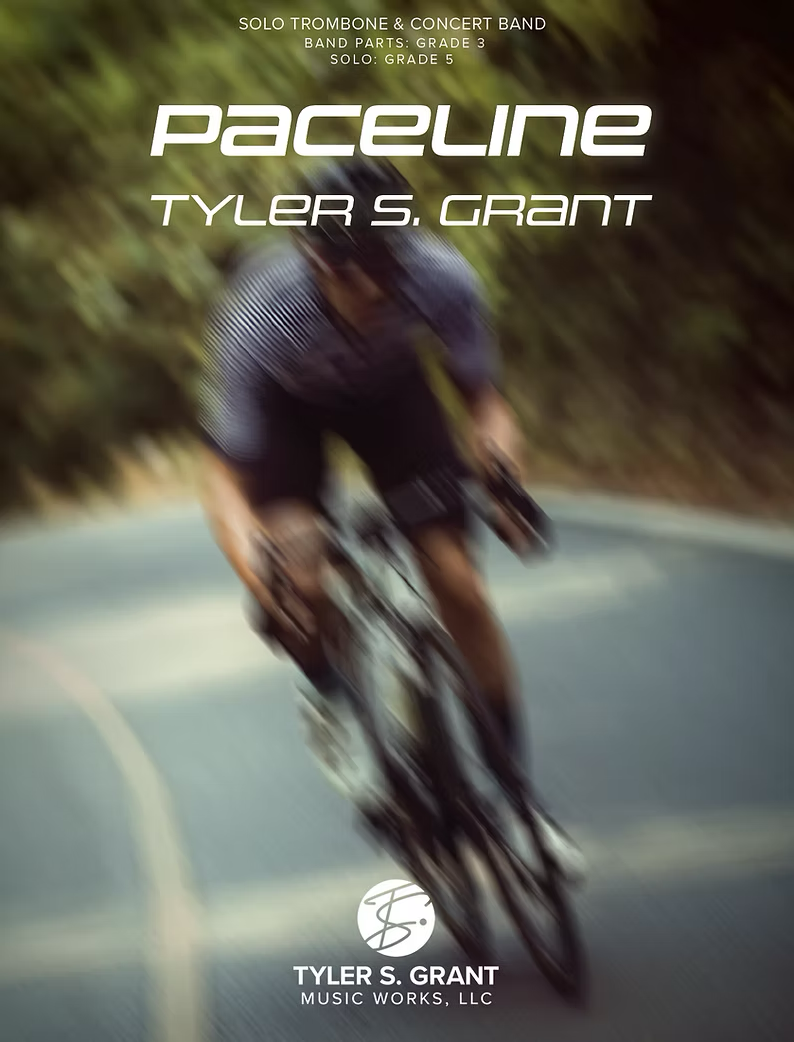
Paceline takes its title from the cycling technique where riders travel in a tight, streamlined line to conserve energy and maintain high speed. Tyler S. Grant reflects this nonstop forward drive in the form of energetic rhythm mixed with intense melodies and motifs that pass quickly between sections like cyclists taking turns at the front of the line, each leading each other forward. The music shifts between sparks of vigorous intensity and brief moments of calm before pushing to the ordeal of a final, exhilarating sprint. This piece is filled with motion and teamwork, which is especially representative of band community--- Paceline celebrates the competence of moving forward together.
My vision of the piece: When I hear Paceline, I imagine the woodwinds with repeating notes dropping in like the very first raindrops on a still surface. One by one, they gather in a flowing stream, continuous and unbroken, carrying every melody like a leaf set drifting downstream.
Each motif feels like time itself being passed from one part of the river to the next.
The dramatic surges in the music crash like giant foaming waterfalls (accentuated by percussion), moments where life suddenly tumbles, accelerates, and gets overwhelmingly intense. Yet the trombone soloist is like the powerful will of support and determination that keeps everything flowing determinedly, never stopping. Even in the calm moments, it's always trickling, moving, always alive, always finding its way forward.
To me, Paceline becomes less about cycling and more about life's own momentum. How things change, how they rush, how they quiet, and how ---no matter what--- keeps flowing on and on unceasingly.
Springtime Ride
Swan Maiden Press
2018 • Grade 2 • 3:45
Program Notes by Zivah Golden, Clarinet
Our next piece we will be playing tonight is written by Erika Svanoe; who was a director of the athletic bands at the University of New Hampshire, and now serves as a clinician for high schools and universities. Her first published piece was The Haunted Carousel, and was featured at the Midwest Clinic. Her inspiration for this piece is a group of kids riding bikes through the streets, much like she did when she was a kid.
Program Notes from the composer:
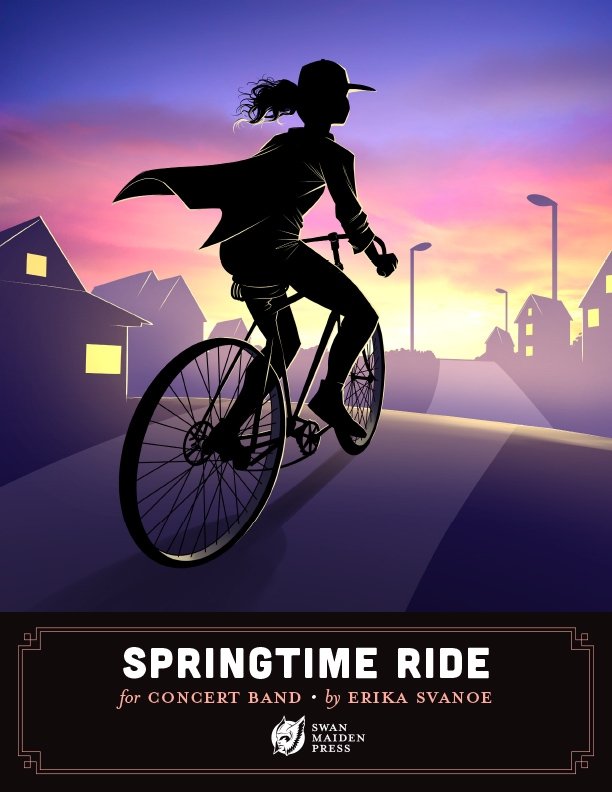
The idea behind Springtime Ride is a group of young people riding bikes through their neighborhood when the weather finally warms up enough to do so. I wanted to capture the freedom and optimism that has always given me, especially as a kid when bike riding was my independent mode of transportation. I was recently reminded of these feelings while watching the series “Stranger Things,” which made me think of two of my favorite childhood movies “E.T.” and “The Goonies.” All of these have fantastic scenes of kids on bikes, and there may be a bit of a movie score sound in Springtime Ride due to these influences. At the end of the piece, I picture the kids pedaling off into the sunset.
Dark Star
Excelcia Music Publishing
2018 • Grade 1 • 2:05
Program Notes by Aadya Kishore, Horn
Christina Huss's concert band piece Dark Star was inspired by her reading about a looming asteroid that would narrowly miss Earth. Huss wrote the piece to evoke a feeling of urgency in the journey of an approaching asteroid as it hurtles closely toward a planet. The music is intended to provide young band students with a "thrilling musical ride through space”.
The atmosphere Dark Star provides is a high-energy driving piece from the beginner to the end. With the low brass and low woodwind sections being featured a lot. For the educational focus, Huss uses a variety of musical devices suitable for young players, including trills, dynamics, syncopated rhythms, and strong melodies and countermelodies, providing opportunities for students to expand their lower playing range. Furthermore, the impact this has on the audience is that Dark Star is crafted to be a captivating and thrilling concert experience. In conclusion, Christina Huss's Dark Star successfully uses the inspiring real-world idea of an asteroid's near-pass to create a thrilling, high-energy, and educationally impactful concert band piece that engages both young performers and audiences.
Jingle Jam
RWS Music Company
2024 • Grade 2 • 2:30
Program Notes Compiled by Joyce Li, Bassoon
If you want to get your audience clapping along, look no further! Jingle Jam is a feel-good holiday celebration that features many of your favorite classics, including “Up on the Housetop”, “Deck the Halls”, “The 12 Days of Christmas”, “O Tannenbaum”, “God Rest Ye Merry Gentlemen”, and of course, “Jingle Bells!” A host of percussion instruments ensures everyone feels the groove and prepares them to embrace the spirit of the season! Jingle Jam is the perfect way to conclude your holiday concert!
From the inside of the score:
Jingle Jam is a feel good holiday celebration that features many of your holiday classics, including Up on the Housetop, Deck the Halls, The 12 Days of Christmas, O Tannenbaum, God Rest Ye Merry Gentlemen, and of course, Jingle Bells.Sleigh bells, tambourine, slapstick, and a host of other percussion instruments help get everyone feeling the groove of the piece and ready to embrace the spirit of the season!
The Great Rubber Chicken Galop
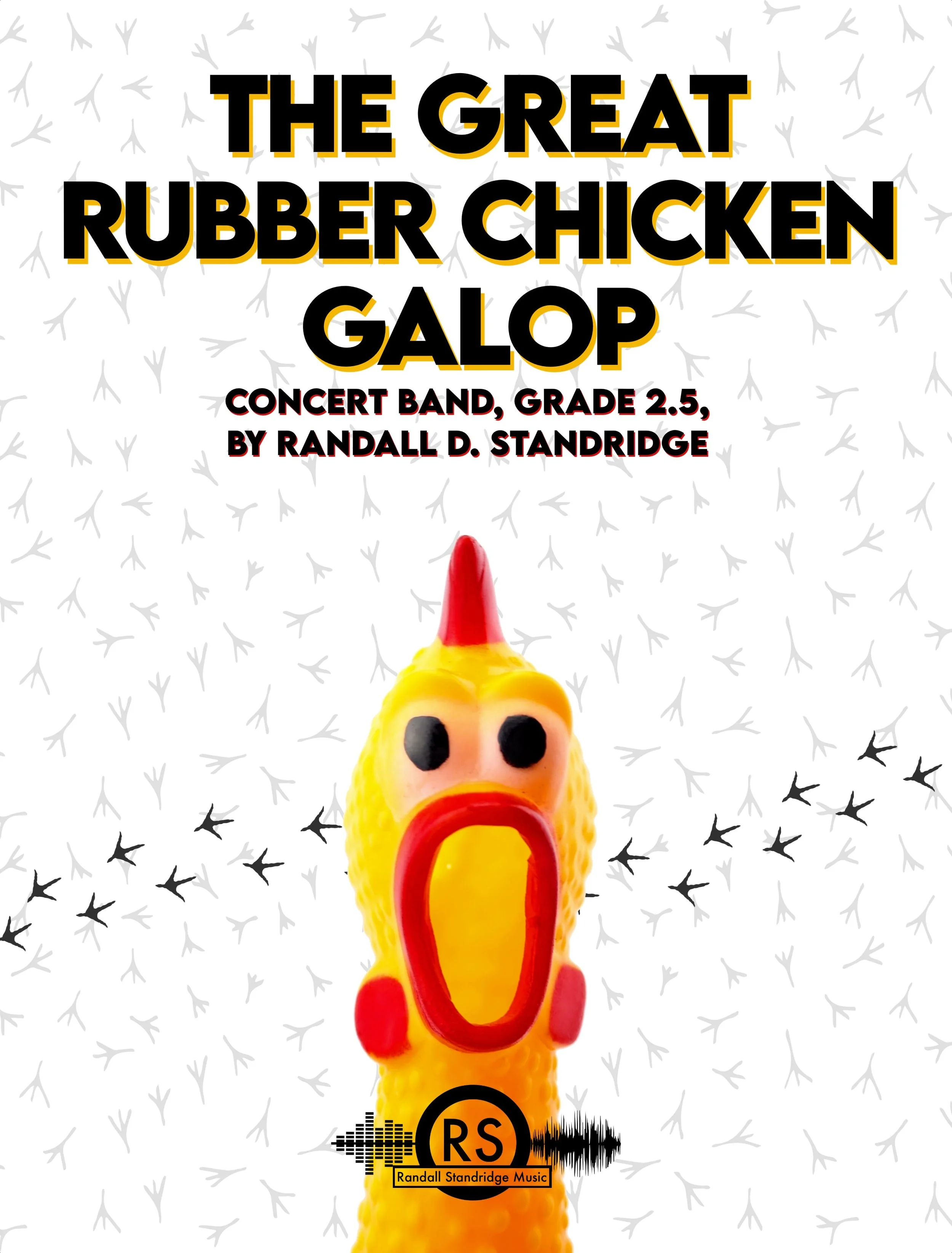
Randall Standridge Music
2024 • Grade 3 • 2:30
Program Notes Compiled by Gianna Lin, Alto Sax
In symphonic music, we are often celebrated for portraying the vast array of human emotions. Composers are lauded if they convey love, passion, fear, dread, anger, rage, pathos, and sorrow in their works. However, the same cannot be said about humor. Oftentimes, when humor is the main objective of a work, the piece is written off as “silly,” “not serious,” or as somehow being automatically less worthy of praise than the works that express the other aspects of the human condition. It’s a stupid idea, but one that has unfortunately taken root in our music culture.
With this in mind, I was delighted beyond belief when Becca Clemens, director of the Margaret B. Pollard 8th Grade Band, contacted me to write a commission for her ensemble’s performance at their state conference. When I asked if there were any content or stylistic requirements, she had one request:
“It has to have rubber chickens in it.”
I paused.
“I beg your pardon?”
“We want a piece that uses rubber chickens.”
With this in mind, I set out to write the piece you will hear or play shortly.
The Great Rubber Chicken Galop was written to sound as if it belonged on stage at a vaudeville performance in the 1920s. The combination of Galop form, ragtime harmonies, and rhythms, as well as the horde of rubber chickens, creates a piece that is just as serious in its crafting and construction as it is unserious in its comedic effect. I hope audiences will be simultaneously wowed by the virtuosity of the players and amused by the presence of squeaking and honking feathered friends.
Lastly, I must admit that I almost fell victim to the very mindset that I described at the beginning of these notes. After writing the piece, I strongly considered not releasing it. Several in the composition/music world already view me as a “lesser” composer due to a variety of factors, and I was hesitant to give them more ammunition in this regard.
However, it’s like the old saying goes.
If they can’t take a joke, forget ‘em.
Peace, Love, and Music - Randy Standy